
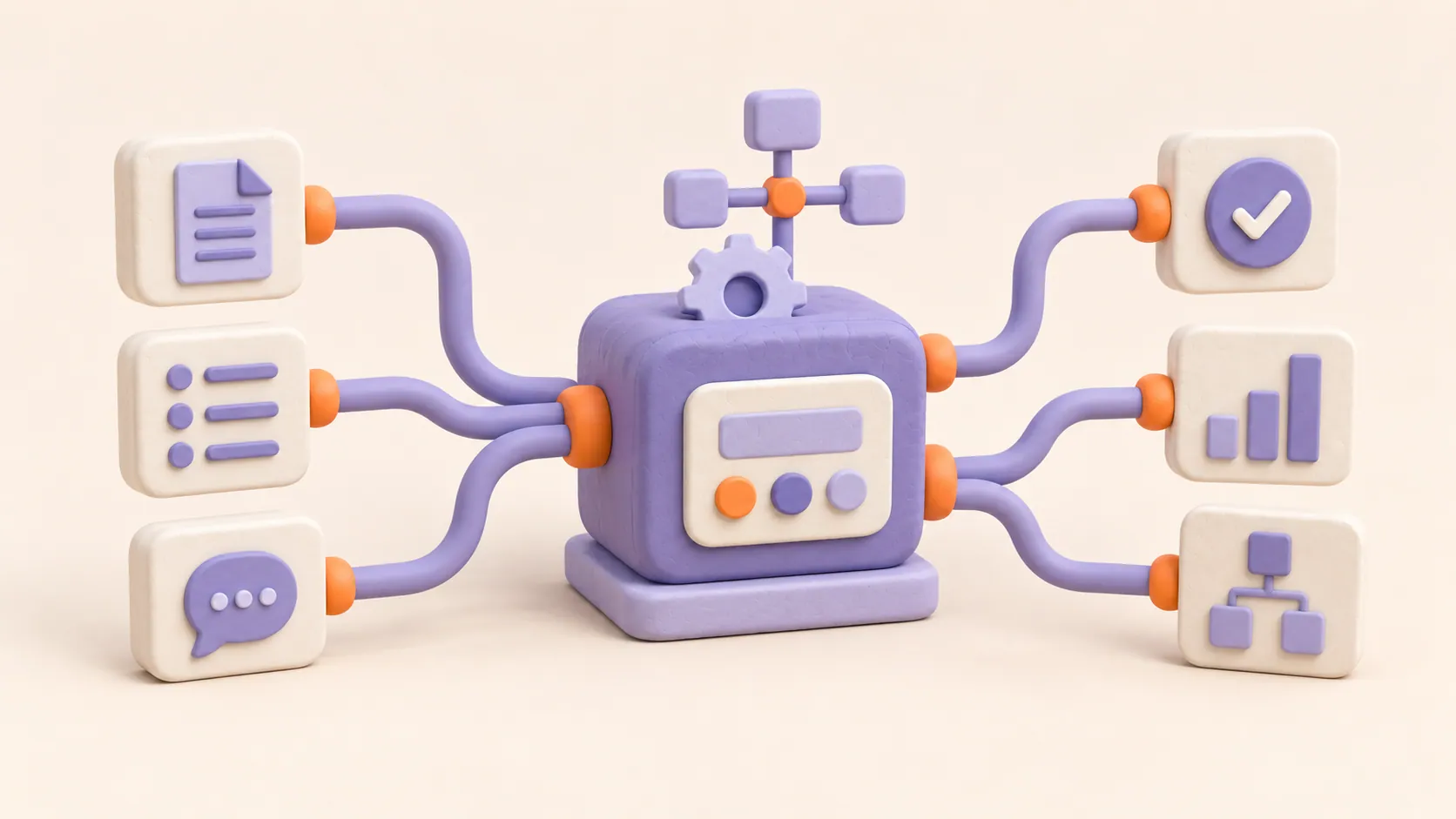

Discover
Understand your business objectives, current workflows and operational challenges.
The Challenge
As businesses grow, their operational processes can become increasingly complex.
Teams may spend significant time on repetitive tasks, manual data handling, disconnected systems and workflows that require multiple steps to complete.
Yet adopting AI is not simply about implementing the latest technology. It is about identifying the right problems, understanding existing workflows and determining where intelligent automation can deliver meaningful value.
Common challenges include:
Repetitive tasks that consume employee time.
Manual processes that create operational bottlenecks.
Information distributed across disconnected systems.
Inconsistent workflows between departments.
Difficulty identifying suitable opportunities for AI adoption.
Uncertainty about where automation will create measurable value.
Challenges integrating new technology into existing operations.
Introducing AI without understanding these challenges can create additional complexity rather than solve the original problem.
The first step towards intelligent automation is understanding how your business works today.
Our Approach to AI & Automation
Megam takes a business-oriented approach to AI and automation.
Rather than beginning with a predetermined technology, we start by understanding the process, the people involved, the desired outcome and the constraints of the existing environment.
We then identify opportunities where AI, automation or workflow improvements may help address the problem.
Our focus is on finding practical ways to reduce unnecessary effort, improve process consistency and support better operational decisions.
We understand first
The process
The people involved
The desired outcome
The constraints of the existing environment
Identify where AI, automation or workflow improvements may help
Business Process Automation
Identify repetitive, rules-based activities that may be suitable for automation. The objective is to reduce avoidable manual effort, improve consistency and allow teams to focus on higher-value work.
AI-Powered Workflows
Explore how AI capabilities can support selected business processes, information handling and workflow activities. The appropriate use case depends on business requirements, available data, integration needs and the required level of human oversight.
Intelligent Process Improvement
Review existing workflows to identify bottlenecks, unnecessary steps and opportunities to simplify the way work moves across teams.
AI & Machine Learning Opportunities
Assess where AI and machine learning approaches may be relevant to business requirements, including information analysis, pattern identification and selected predictive use cases.
Enterprise Technology Integration
Evaluate how automation initiatives may fit into existing applications, infrastructure and operational workflows.
AI Adoption & Implementation Support
Help businesses move from identifying an opportunity to assessing, planning and implementing an appropriate technology approach.
Specific AI models, automation platforms, integrations and implementation capabilities are determined by the requirements and agreed scope of each engagement.
AI & Automation for Manufacturing
Manufacturing organizations operate across interconnected processes, teams, equipment and information systems.
AI and automation may help address selected operational challenges when implemented with a clear understanding of production requirements, data availability and existing systems.
Megam's manufacturing-oriented approach focuses on identifying practical opportunities rather than introducing technology without a defined purpose.
Potential areas for assessment include:
Identify suitable office and operational support activities for workflow automation.
Explore ways AI-assisted tools may help organize, process or retrieve business information.
Review workflows across departments to identify unnecessary manual steps and process bottlenecks.
Assess whether available data can support improved reporting, analysis or selected intelligent applications.
Explore automation opportunities within appropriate IT and technology-management processes.
Each opportunity should be assessed against:
A Structured Approach to Technology Adoption
Discover
Understand your business objectives, current workflows and operational challenges.

Identify
Evaluate processes where AI or automation may offer practical benefits.

Design
Define the proposed solution, technical requirements, integration considerations and success measures.

Implement
Develop or configure the agreed solution within the defined scope.

Evaluate & Improve
Assess results against agreed objectives and identify opportunities for refinement.
Business-First Thinking
We start with the operational challenge, not the technology trend.
Solutions Adapted to Your Processes
We consider your workflows, existing systems and business objectives when shaping the solution.
Technology with a Clear Purpose
We focus on identifying appropriate use cases and defining what success should look like before implementation.
Direct Founder Engagement
Gain access to leadership when strategic technology decisions and business priorities require closer collaboration.
Support Through Implementation
We aim to support the journey from problem definition and solution design to implementation and adoption.
Can't find what you're looking for?
Contact us
for any enquiries
AI and automation solutions use technologies to support tasks, workflows, analysis and selected decision-making processes. Automation can execute defined tasks, while AI can help perform activities such as interpreting information or identifying patterns, depending on the application.